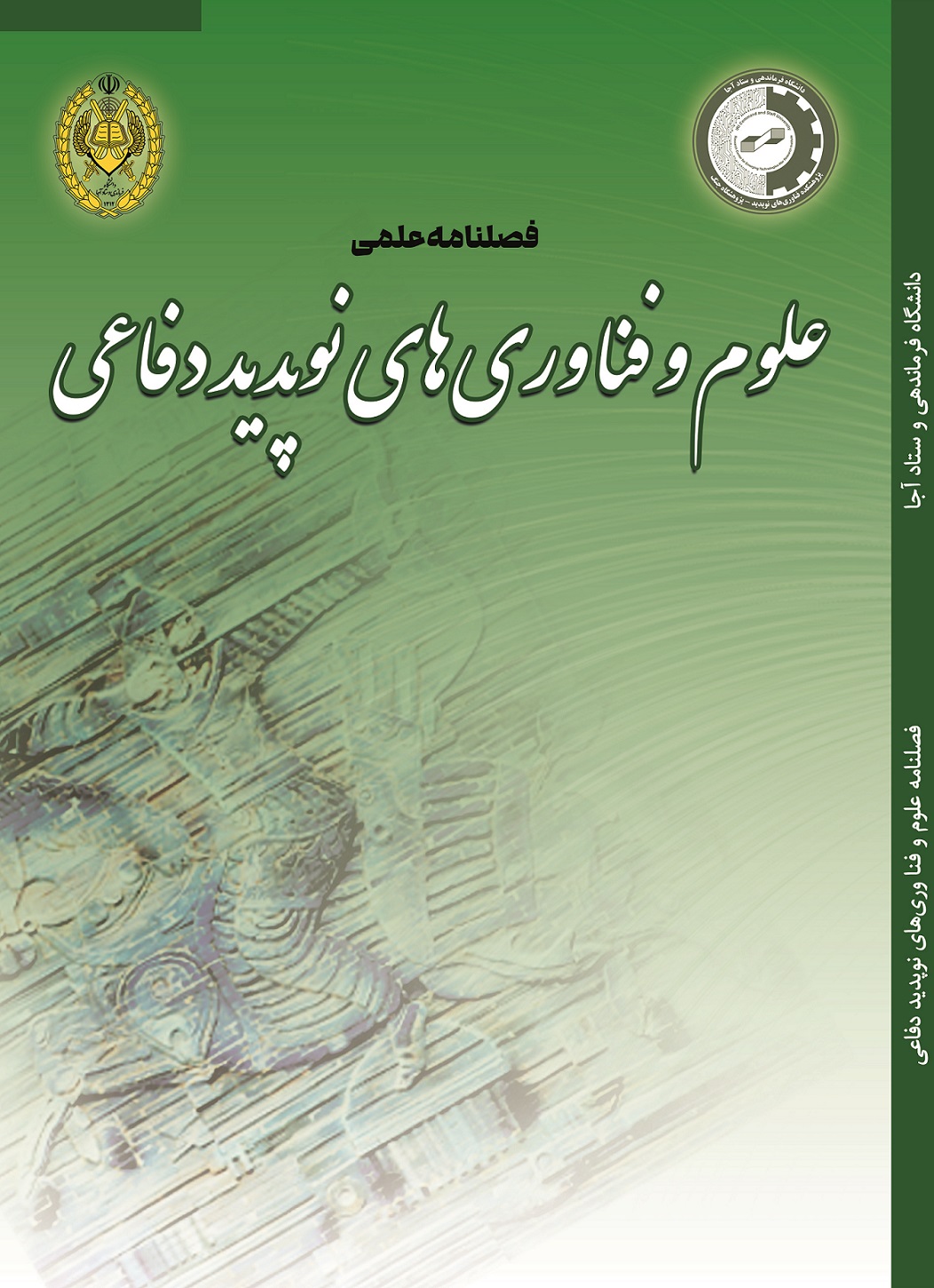
Defensive Future Studies

Defensive Future Studies


  • Journal Title: Defensive Futures Studies
  • Country: Iran
  • Owner & Publisher: IRI Military Command and Staff University
  • Rate in ISC: Q1 (0.771)
  • Rate in MSRT: A
  • Print ISSN: 2588-428X
  • Online ISSN: 2645-7172
  • Format: Printed and Online
  • Frequency: Quarterly
  • Acceptance Rate: 23%
  • Language: Persian with English abstracts
  • Coverage: Defensive Futures Studies
  • Type of Journal: Academic
  • Type of Papers: Applied Studies, Case studies, Methodology
  • Advance Access: Yes
  • Indexed & Abstracted: Yes
  • Peer Review Policy: Double-blind
  • Plagiarism Checker: iThenticate, Samimnoor (Persian)
  • Average Review Time: 4-8 Weeks
  • Article Processing Charges: Free for review process and publication
  • Type of License: CC-BY-NC-ND
  • Type of Access: Open Access (OA)
  • Available at: www.dfsr.ir
  • Contact E-mail: dfsr@casu.ac.ir


***Copyright: the Journal allows the author(s) to hold the copyright without restrictions.***

.................................................................................................................................. 

**This journal is following of Committee on Publication Ethics (COPE) and complies with the highest ethical standards in accordance with ethical laws.**

..................................................................................

***Received scientific rank "A" in the evaluation of 2021 and 2022 in the Ministry of Science, Research and Technology of Iran***


Defensive Futures Studies (DFSR) operates under the Creative Commons Licence CC-BY-NC-ND. This allows for the reproduction of articles, free of charge, for non-commercial use only and with the appropriate citation information. All authors publishing with Defensive Futures Studies (DFSR) accept these as the terms of publication.

This work is licensed under a Creative Commons Attribution-NonCommercial-NoDerivatives 4.0 International License.

This license allows others to download the works and share them with others as long as they credit them, but they can’t change them in any way or use them commercially.

............................................................................................

Defensive Futures Studies (DFSR) is loyal to open access for academic work, permitting any users to read, download, copy, distribute, print, search, or link to the full texts of its articles and to use them for any other lawful purpose. All the articles published in this journal are free to access immediately from the date of publication. We do not charge any fees for any reader to download articles for their own scholarly use.

.............................................................................................................................

 This journal uses Grammarly’s plagiarism checker for English language papers.

-----------------

----------------------------


Current Issue: Volume 11, Issue 42, Autumn 2026 

Keywords Cloud

  • Futures studies
  • Strategy
  • Future Studies
  • Iran
  • Scenario Planning
  • scenario
  • technology
  • Futurology
  • foresight
  • artificial intelligence
  • defense industry
  • Uncertainty
  • Future Wars
  • grounded theory
  • Future Threats
  • drivers
  • Strategic Foresight
  • Air Defense
  • Future War
  • National Security
  • Saudi Arabia
  • future study
  • Threat
  • Islamic Republic of Iran
  • fuzzy theory
  • Cyber Defense
  • Trend Analysis
  • Armed Forces
  • defense organizations
  • Aja
  • Security
  • Meta-synthesis
  • Scenario Writing
  • Passive defense
  • Logistics
  • wargaming
  • science and technology
  • actor analysis
  • pattern
  • Fuzzy Delphi
  • geopolitics
  • Threats
  • supply chain
  • Military Security
  • system dynamics
  • Azerbaijan
  • Cognitive warfare
  • thematic analysis
  • Cyberspace
  • ANP
  • Defense diplomacy
  • Information Technology
  • Social Security
  • crisis management
  • Emerging technologies
  • Future research
  • model
  • Air Force
  • mixed approach
  • Organizational Culture
  • Yemen
  • Simulation
  • Framework
  • Corporate Foresight
  • Afghanistan
  • Command and Control
  • joint operation
  • key factors
  • Budgeting
  • Persian Gulf
  • joint operations
  • Cultural Defense
  • Data Mining
  • Technology scouting
  • Consequences
  • Supreme Leader
  • soft power
  • fuzzy Analytic Hierarchy Process
  • Military threats
  • army
  • Championship Sports
  • Game Theory
  • Cyber Power
  • Factor analysis
  • cognitive readiness
  • Innovation
  • non-operating defense
  • Spatial Data Infrastructure (SDI)
  • Conceptual model
  • defense policy
  • manpower
  • Hybrid warfare
  • human capital
  • nuclear deal
  • SWOT Model
  • PSO algorithm
  • high technology
  • Islamic-Persian model of development
  • Iraq
  • Future Warfare
  • Modeling
  • Outsourcing
  • Open innovation
  • defense futures studies
  • Security game
  • COVID-19
  • Defense
  • Arms Race
  • Scientometrics
  • Deep Learning
  • Futures Research
  • doctrine
  • Interpretive Structural Modeling
  • Driver
  • Environmental Scanning
  • Nash equilibrium
  • Soft War
  • Army of the Islamic Republic of Iran
  • sanctions
  • innovation management
  • America
  • West Asia
  • Risk Management
  • need assessment
  • Signals Intelligence
  • AHP method
  • Military Technologies
  • Emergency logistics
  • structure
  • -Russia- Ukraine
  • TWO-PERSON GAME
  • Cognitive Bias
  • contemporary warfare
  • Demand Forecasting Methods
  • \"Iran\'s nuclear program\"
  • Climate change
  • Physical Fortifications
  • Intelligent human resources
  • Theory
  • Defense Strategy
  • Wargaming design
  • Domestic political economy
  • Climate Scenarios
  • exploratory scenario writing
  • Location dimensions
  • Wild Cards
  • Physiological Equivalent Temperature
  • rapid reaction battalions of urban warfare
  • automatic target detection
  • Defensive power
  • critical infrastructure
  • Non-Military Defense
  • The Islamic Republic of Iran
  • Prediction and Forecasting Models
  • military role
  • Defense Geopolitics
  • Organizational Development
  • Ansarullah
  • Logistic pattern
  • cognitive flexibility
  • Command/management layer
  • situational awareness
  • Integrated Command and Control
  • Islamic Revolution of Iran
  • Ground motor vehicle equipment
  • cyber support
  • Fuzzy Credibility programming
  • image processing
  • : Future threats
  • Corporate Governance
  • RAND
  • UAVs
  • zero sum game
  • Importance - Performance Analysis
  • Training camps
  • ideology
  • time management
  • -security arrangements
  • Efficiency
  • Environmental security
  • maritime society
  • Search algorithm
  • Human capital development
  • Performance management\"
  • Screenwriting
  • Internal factor evaluation (IFE) and external factor evaluation (EFE) matrices
  • Analysis of mutual effects
  • Strategic Risk Assessment
  • Science and Technology development
  • Holy Quran
  • Khuzestan
  • Revolution in Military Affairs (RMA)
  • military influence
  • Multi-objective Decision Making
  • Analytical Hierarchy
  • Training
  • MAVs
  • defense resilience
  • Clustering

Related Journals