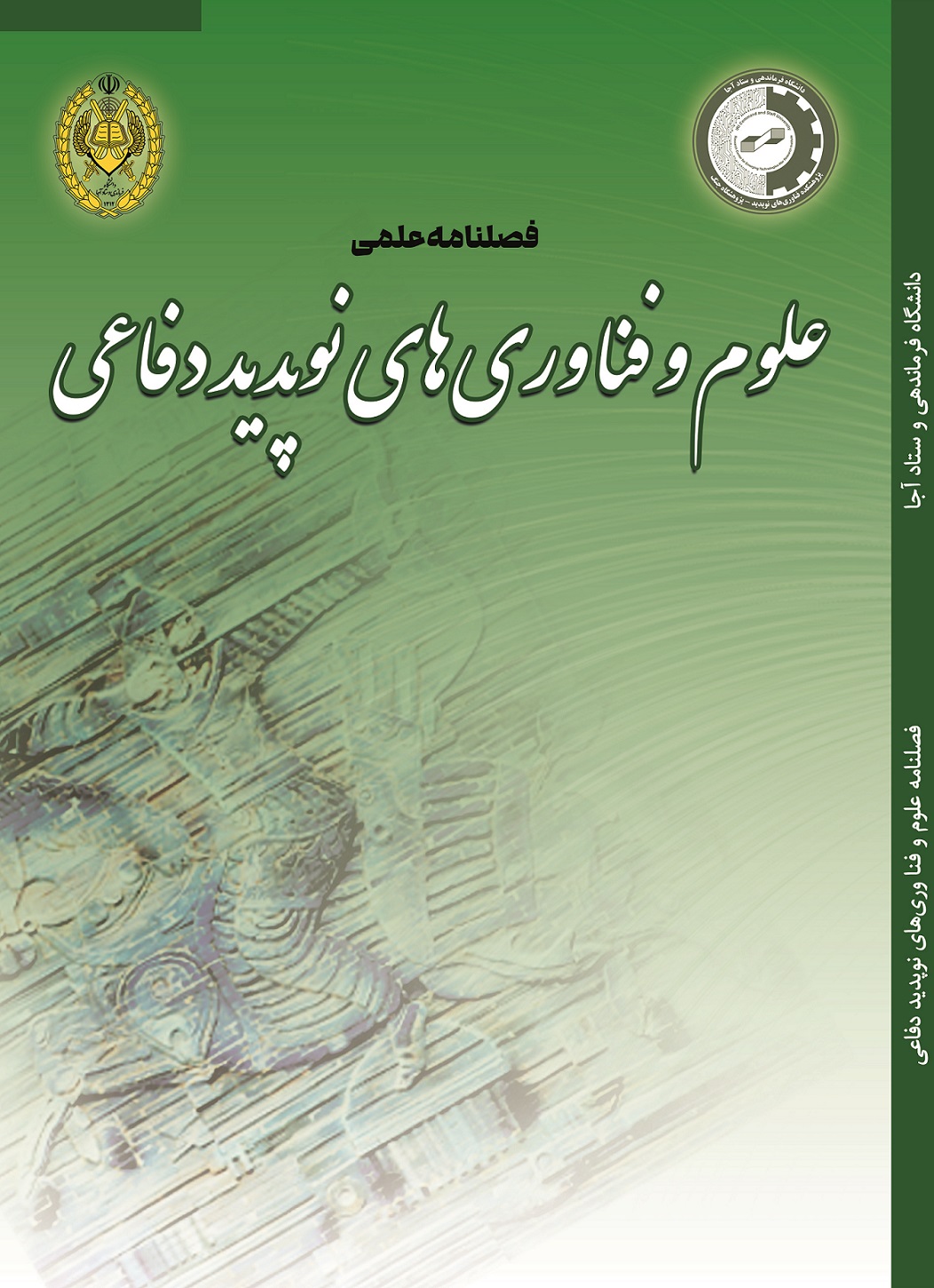
Defensive Future Studies

Defensive Future Studies


  • Journal Title: Defensive Futures Studies
  • Country: Iran
  • Owner & Publisher: IRI Military Command and Staff University
  • Rate in ISC: Q1 (0.771)
  • Rate in MSRT: A
  • Print ISSN: 2588-428X
  • Online ISSN: 2645-7172
  • Format: Printed and Online
  • Frequency: Quarterly
  • Acceptance Rate: 23%
  • Language: Persian with English abstracts
  • Coverage: Defensive Futures Studies
  • Type of Journal: Academic
  • Type of Papers: Applied Studies, Case studies, Methodology
  • Advance Access: Yes
  • Indexed & Abstracted: Yes
  • Peer Review Policy: Double-blind
  • Plagiarism Checker: iThenticate, Samimnoor (Persian)
  • Average Review Time: 4-8 Weeks
  • Article Processing Charges: Free for review process and publication
  • Type of License: CC-BY-NC-ND
  • Type of Access: Open Access (OA)
  • Available at: www.dfsr.ir
  • Contact E-mail: dfsr@casu.ac.ir


***Copyright: the Journal allows the author(s) to hold the copyright without restrictions.***

.................................................................................................................................. 

**This journal is following of Committee on Publication Ethics (COPE) and complies with the highest ethical standards in accordance with ethical laws.**

..................................................................................

***Received scientific rank "A" in the evaluation of 2021 and 2022 in the Ministry of Science, Research and Technology of Iran***


Defensive Futures Studies (DFSR) operates under the Creative Commons Licence CC-BY-NC-ND. This allows for the reproduction of articles, free of charge, for non-commercial use only and with the appropriate citation information. All authors publishing with Defensive Futures Studies (DFSR) accept these as the terms of publication.

This work is licensed under a Creative Commons Attribution-NonCommercial-NoDerivatives 4.0 International License.

This license allows others to download the works and share them with others as long as they credit them, but they can’t change them in any way or use them commercially.

............................................................................................

Defensive Futures Studies (DFSR) is loyal to open access for academic work, permitting any users to read, download, copy, distribute, print, search, or link to the full texts of its articles and to use them for any other lawful purpose. All the articles published in this journal are free to access immediately from the date of publication. We do not charge any fees for any reader to download articles for their own scholarly use.

.............................................................................................................................

 This journal uses Grammarly’s plagiarism checker for English language papers.

-----------------

----------------------------


Current Issue: Volume 11, Issue 42, Autumn 2026 

Keywords Cloud

  • Futures studies
  • Strategy
  • Future Studies
  • Iran
  • scenario
  • Scenario Planning
  • Futurology
  • foresight
  • technology
  • Uncertainty
  • defense industry
  • Future Wars
  • artificial intelligence
  • grounded theory
  • drivers
  • Saudi Arabia
  • Future Threats
  • Air Defense
  • Strategic Foresight
  • National Security
  • Future War
  • Trend Analysis
  • fuzzy theory
  • Aja
  • defense organizations
  • Armed Forces
  • Security
  • future study
  • Cyber Defense
  • Meta-synthesis
  • Logistics
  • Islamic Republic of Iran
  • Scenario Writing
  • Threat
  • wargaming
  • Air Force
  • Social Security
  • Cyberspace
  • Future research
  • science and technology
  • Information Technology
  • Cognitive warfare
  • Threats
  • system dynamics
  • Fuzzy Delphi
  • geopolitics
  • thematic analysis
  • ANP
  • Military Security
  • pattern
  • model
  • crisis management
  • actor analysis
  • Defense diplomacy
  • supply chain
  • Azerbaijan
  • Passive defense
  • Yemen
  • Soft War
  • Interpretive Structural Modeling
  • mixed approach
  • Arms Race
  • Open innovation
  • SWOT Model
  • Scientometrics
  • joint operation
  • Army of the Islamic Republic of Iran
  • joint operations
  • America
  • Emerging technologies
  • Supreme Leader
  • Spatial Data Infrastructure (SDI)
  • soft power
  • innovation management
  • fuzzy Analytic Hierarchy Process
  • Cultural Defense
  • non-operating defense
  • Factor analysis
  • PSO algorithm
  • Technology scouting
  • defense policy
  • human capital
  • Cyber Power
  • defense futures studies
  • Innovation
  • Budgeting
  • Conceptual model
  • army
  • Consequences
  • cognitive readiness
  • key factors
  • Military threats
  • nuclear deal
  • Championship Sports
  • Game Theory
  • Defense
  • Future Warfare
  • Iraq
  • high technology
  • Modeling
  • Outsourcing
  • Afghanistan
  • Islamic-Persian model of development
  • Persian Gulf
  • Command and Control
  • Framework
  • Security game
  • Deep Learning
  • Corporate Foresight
  • Driver
  • COVID-19
  • doctrine
  • Environmental Scanning
  • Organizational Culture
  • Simulation
  • West Asia
  • sanctions
  • Nash equilibrium
  • Futures Research
  • Hybrid warfare
  • Data Mining
  • Army Staff Cadre
  • Robust Prioritizatio
  • mixed research of obstacles and solutions
  • Technology-Driven Threats
  • Professional Military
  • Military Spending
  • Human Resource Development
  • Planning pattern
  • co-authorship
  • 1410 horizon
  • Two-way relay network
  • industrial command and control systems
  • Comprehensive Scenario Planning Model
  • Indicators
  • World order
  • Organizational drivers
  • mission environment dynamics
  • transformation
  • critical success factors
  • diplomacy
  • future-oriented defense culture
  • Multi-ّّfactor systems
  • Smart Balancing
  • time management
  • Integrated Command and Control
  • Risk Management
  • Emergency logistics
  • Signals Intelligence
  • Cop and robber problem
  • structure
  • TWO-PERSON GAME
  • Cognitive Bias
  • Climate change
  • Sayyad Shirazi
  • data systems
  • productivity
  • Domestic political economy
  • Theory
  • AHP method
  • Defense Strategy
  • Climate Scenarios
  • need assessment
  • Quantum Technology
  • Location dimensions
  • Wild Cards
  • contemporary warfare
  • critical infrastructure
  • Non-Military Defense
  • -Russia- Ukraine
  • Vehicle scheduling problem
  • Proactivity in career development
  • automatic target detection
  • global strategies
  • Decision making
  • Ansarullah
  • Intelligent human resources
  • Prediction and Forecasting Models
  • Electronic Intelligence
  • Future research and development
  • Organizational Development
  • image
  • image processing
  • Future Wheel
  • scoping review
  • Weak Signal(s)
  • Command and Control (C2) System
  • Markovian Strategy
  • Logistic pattern
  • Spatial data
  • Hypersonic Weapons,
  • Radar Passive Defense
  • Network interdiction
  • Futuristic research
  • cyber threats\"
  • MAVs
  • Structural analysis
  • knowledge-base
  • Training

Related Journals